Scalar and Cross Products of 3D Vectors
The scalar (or dot product) and cross product of 3 D vectors are defined and their properties discussed and used to solve 3D problems.
Scalar (or dot) Product of Two Vectors
The scalar (or dot) product of two vectors \( \vec{u} \) and \( \vec{v} \) is a scalar quantity defined by:
\[ \vec{u} \cdot \vec{v} = || \vec{u} || \, || \vec{v} || \cos \theta \]
where \( || \vec{u} || \) is the magnitude of vector \( \vec{u} \), \( || \vec{v} || \) is the magnitude of vector \( \vec{v} \) and \( \theta \) is the angle between the vectors \( \vec{u} \) and \( \vec{v} \).
If the components of vectors \( \vec{u} \) and \( \vec{v} \) are known: \( \vec{u} = (u_x , u_y ,u_z)\) and \( \vec{v} = (v_x , v_y , v_z) \), it can be shown that the scalar product may be expressed as follows:
\[ \vec{u} \cdot \vec{v} = u_x v_x + u_y v_y + u_z v_z \]
Theorems on Scalar Products
If \( \vec{u} \), \( \vec{v} \) and \( \vec{w} \) are vectors and k is a scalar, then
- ) \( \vec{u} \cdot \vec{v} = \vec{v} \cdot \vec{u} \)
- ) \( \vec{u} \cdot (\ \vec{v} + \vec{w} ) = \vec{u} \cdot \vec{v} + \vec{u} \cdot \vec{w} \)
- ) \( \vec{u} \cdot \vec{u} = ||\vec{u} ||^2 \)
- ) \( \vec{u} \cdot \vec{v} = 0 \; \) if and only if \( \; \theta = \pi/2 \), if both \( \vec{u} \) and \( \vec{v} \) are non zero vectors.
- ) \( (k \vec{u}) \cdot \vec{v} = \vec{u} \cdot ( k\vec{v}) = k ( \vec{u} \cdot \vec{v} ) \)
- ) \(|\vec{u} \cdot \vec{v} | \le ||\vec{u}|| ||\vec{v}|| \)
7) \(||\vec{u} + \vec{v} || \le ||\vec{u}|| + ||\vec{v}|| \)
Example 1
Approximate, to the nearest degree, the angle between the vectors \(\vec{v} = \lt -2,3,1> \text{and} \; \vec{u} = \lt 0,-1,4>\).
solution
Express the scalar product of the two vectors using the magnitude and angle \( \theta \) between them and the coordinates as follows:
\[\vec{v} \cdot \vec{u} = ||\vec{v} || || \vec{u} || cos \theta = (-2)(0) + (3)(-1) + (1)(4) = 1 \]
\[ ||\vec{v} || = \sqrt{(-2)^2+3^2+1^2} = \sqrt{14}\]
\[ ||\vec{u} || = \sqrt{0^2+(-1)^2+4^2} = \sqrt{17} \]
\[ cos\theta = \dfrac{1}{||\vec{v} || || \vec{u} ||} = \dfrac{1}{\sqrt{14}\sqrt{17}} \]
\[ \theta = \arccos(\dfrac{1}{\sqrt{14}\sqrt{17}} ) \approx 86^{\circ}\]
More explanations on finding the angle between vectors on a video.
Example 2
Find \( a \) so that the vectors \( \lt a,-6,3 \gt \) and \( \lt1,0,-2> \) are perpendicular.
solution
For two vectors to be perpendicular, their scalar product must be equal to zero.
\[ \lt a,-6,3 \gt \cdot \lt1,0,-2> = a(1) + (-6)(0)+(3)(-2) = a - 6 = 0 \]
Solve for a
\[ a = 6\]
Scalar and Vector Projection of a Vector onto Another
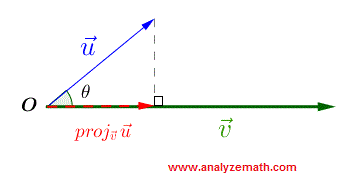
In many applications, it is important to find the component of a vector in the direction of another vector. As shown below, vector \( \vec{u}\) is projected onto vector \( \vec{v}\) by dropping a perpendicular from the terminal point of \( \vec{u}\) to the line through \( \vec{v}\). The component of \( \vec{u}\) along \( \vec{v}\) is a scalar quantity called the scalar projection and is given by
\( \text{comp}_{\vec{v}}\vec{u} = ||\vec{u}|| \cos \theta \) .
The vector projection of \( \vec{u}\) on \( \vec{v}\) is a vector quantity obtained by multiplying the component \( \text{comp}_{\vec{v}}\vec{u} \) by the unit vector in the direction of vector \( \vec{v}\) and is given by
\( \text{proj}_{\vec{v}}\vec{u} = ||\vec{u}|| \cos \theta \dfrac{\vec{v}}{||\vec{v}||} = \dfrac{\vec{u}\cdot\vec{v}}{||v||^2} \vec{v}\) .
Cross (or vector) Product of Two Vectors
The cross (or vector) product of two vectors \( \vec{u} = (u_x , u_y ,u_z)\) and \( \vec{v} = (v_x , v_y , v_z) \) is a vector quantity defined by:
\[ \vec{u} \times \vec{v} = {\begin{vmatrix}\vec{i}& \vec{j} &\vec{k} \\ u_x & u_y & u_z \\ v_x & v_y & v_z \end{vmatrix}} \]
\[ = {\begin{vmatrix} u_y & u_z \\ v_y & v_z \end{vmatrix}} \vec{i} - {\begin{vmatrix}u_x & u_z\\ v_x & v_z\end{vmatrix}} \vec{j} + {\begin{vmatrix}u_x & u_y\\ v_x & v_y\end{vmatrix}} \vec{k} \]
The cross product \( \vec{u} \times \vec{v} \) is perpendicular to both \( \vec{v} \) and \( \vec{u} \)
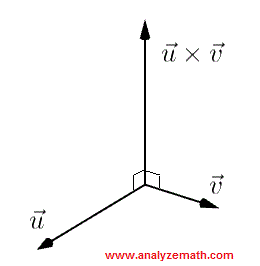 The right hand rule, to find the direction of the cross product, is as follows: point the index in the direction of \( \vec {u} \), the middle finger in the direction of \( \vec{v} \) and the direction of the cross product \( \vec {u} \times \vec {v} \) is in the same direction as that of the thumb.

Theorems on Cross Products
If \( \vec{u} \), \( \vec{v} \) and \( \vec{w} \) are vectors and k is a scalar, then
- ) The cross product \( \vec{u} \times \vec{v} \) is perpendicular to both \( \vec{v} \) and \( \vec{u} \)
- ) \( \vec{u} \times \vec{v} = - \vec{v} \times \vec{u} \)
- ) \( \vec{u} \times \vec{v} = 0 \) if and only if \( \vec{u} \) and \( \vec{v} \) are parallel , if both \( \vec{u} \) and \( \vec{v} \) are non zero vectors.
- ) \( \vec{u} \times (\ \vec{v} + \vec{w} ) = \vec{v} \times \vec{u} + \vec{u} \times \vec{w} \)
- ) \( (k \vec{u}) \times \vec{v} = \vec{u} \times ( k\vec{v}) = k ( \vec{u} \times \vec{v} ) \)
- ) \( ||\vec{u} \times \vec{v} || = ||\vec{u}|| ||\vec{v}|| sin \theta\) , where \( \theta \) is the angle between \( \vec{u}\) and \( \vec{v} \).
Area of a Parallelogram
A parallelogram is a quadrilateral (4 sides) with opposite sides parallel. In the figure below is shown the parallelogram A, B, C and D. Hence, we have equality between the vectors.
\[ \vec{AB} = \vec{DC} \quad \text{and} \quad \vec{AD} = \vec{BC} \]
The area of the parallelagram is given by \[ || \vec{AB} \times \vec{AD} || \]
 The area of a triangle may be calculated as half the area the corresponding parallelogram.
Volume of a Parallelepiped
A parallelepiped is a 3d figure formed by 6 parallelograms as shown in the figure below. We have equality between several vectors.
\[ \vec{AE} = \vec{DH} = \vec{CG} = \vec{BF} = \vec{u} \]
\[ \vec{AD} = \vec{BC} = \vec{EH} = \vec{FG} = \vec{v}\]
\[ \vec{AB} = \vec{DC} = \vec{EF} = \vec{HG} = \vec{w}\]
The volume V of the parallelepiped is given by
\[ \text{V} = |\vec{u}\cdot (\vec{v} \times \vec{w})| = | \vec{v}\cdot (\vec{w} \times \vec{u})| = | \vec{w}\cdot (\vec{v} \times \vec{u})| \]

Example 3
Calculate the cross product of the vectors \(\vec{u} = \lt 1,1,3 >\) and \(\vec{v} = \lt 1,0,2 > \).
A video on how to find the Cross Product of Two Vectors with detailed explanations.
solution
\[ \vec{u} \times \vec{v} = {\begin{vmatrix}\vec{i}& \vec{j} &\vec{k} \\ 1 & 1 & 3 \\ 1 & 0 & 2 \end{vmatrix}} = {\begin{vmatrix} 1 & 3 \\ 0 & 2 \end{vmatrix}} \vec{i} - {\begin{vmatrix}1 & 3\\ 1 & 2\end{vmatrix}} \vec{j} + {\begin{vmatrix}1 & 1\\ 1& 0\end{vmatrix}} \vec{k} = 2\vec{i} + \vec{j} -\vec{k} \]
Example 4
Find two unit vectors perpendicular to the vectors \( \vec{u} = \lt 1,-2,1 \gt \) and \( \vec{v} = \lt -2,0,4> \).
solution
The cross product \( \vec{w} = \vec{u} \times \vec{v} \) is a vector perpendicular to both vectors \( \vec{u} \; \text{and} \; \vec{v} \).
Let us calculte \( \vec{u} \times \vec{v} \) as follows:
\[ \vec{w} = \vec{u} \times \vec{v} = {\begin{vmatrix}\vec{i}& \vec{j} &\vec{k} \\ 1 & -2 & 1 \\ -2 & 0 & 4 \end{vmatrix}} \] \[ = {\begin{vmatrix} -2 & 1 \\ 0 & 4 \end{vmatrix}} \vec{i} - {\begin{vmatrix}1 & 1\\ -2 & 4\end{vmatrix}} \vec{j} + {\begin{vmatrix}1 & -2\\ -2 & 0\end{vmatrix}} \vec{k} = -8\vec{i} - 6 \vec{j} - 4 \vec{k} \]
We now need to find a unit vector \( \vec{u_1} \) in the same direction as \( \vec{w} \) and is given by
\[ \vec{u_1} = \dfrac{1}{||\vec{w}||} \vec{w}\]
and a second unit vector \( \vec{u_2} \) in the opposite direction of \( \vec{w} \) and is given by
\[ \vec{u_2} = -\vec{u_1}\]
\( ||\vec{w}|| = \sqrt{(-8)^2+(- 6)^2+(- 4)^2 } = 2\sqrt{29}\)
\[ \vec{u_1} = \dfrac{1}{2\sqrt{29}} (-8\vec{i} - 6 \vec{j} - 4 \vec{k}) = -\dfrac{4}{\sqrt{29}}\vec{i} -\dfrac{3}{\sqrt{29}}\vec{j}-\dfrac{2}{\sqrt{29}}\vec{k}\]
\[ \vec{u_2} = \dfrac{4}{\sqrt{29}}\vec{i} + \dfrac{3}{\sqrt{29}}\vec{j}+ \dfrac{2}{\sqrt{29}}\vec{k}\]
Example 5
Explain why the following statement are not true.
a) \( \vec{u} \times \vec{u} = ||\vec{u}||^2\)
b) \( \vec{u} \cdot (\vec{u} \times \vec{w} )= (\vec{u} \cdot \vec{u}) \times \vec{w} \)
solution
a) The left side \( \vec{u} \times \vec{u} \) is a cross product and the result is a vector. The right side \( ||\vec{u}||^2\) is a scalar quantity. A vector and a scalar cannot be compared.
b) The left side \( \vec{u} \cdot (\vec{u} \times \vec{w} ) \) is a scalar product of \( \vec{u} \) and \( (\vec{u} \times \vec{w} ) \) and the result is a scalar. The right side is the product of a scalar quantity \( \vec{u} \cdot \vec{u} \) and vector \( \vec{w} \) and the result is a vector. A scalar and a vector cannot be compared.
Answer the following Questions
Detailed Solutions and explanations to these questions.
- ) Calculate \( \vec{u} \cdot (\vec{u} \times \vec{v}) \) given that \( \vec{u} = \lt a,b,c \gt \) and \( \vec{v} = \lt d,e,f \gt \).
- ) Find \( k \) so that vectors \( \vec{u} = \lt -2,-k,1 \gt \) and \( \vec{v} = \lt 8,-2,-3 > \) are perpendicular
- )Find \( k \) so that the vectors \( \vec{u} = \lt -3,2,-2 \gt \), \( \vec{v} = \lt 2,1,k> \) and \( \vec{w} = \lt -1,3,-5> \) are on the same plane (or coplanar)?
- ) Find angle \( \theta \) between the vectors \( \vec{u} = \lt 2,0,1 \gt \) and \( \vec{v} = \lt 8,-2,-3 > \).
- ) Find the vector projection of \( \vec{u} = \lt -1,-1,1 \gt \) onto \( \vec{v} = \lt 2,1,1 > \).
- ) Find that \( k \) so that the points \( A(-1,2,k) \), \( B(-3,6,3) \) and \( C(1,3,6) \) are the vertices of a right triangle with a right angle at \( A \).
- ) Given vector \( \vec{v} = \lt 3,-1,-2 \gt \), find the vector \( \vec{u} \) such that \( \vec{v} \times \vec{u} = \lt 4,2,5 > \) and \( ||\vec{u}|| = 3\))
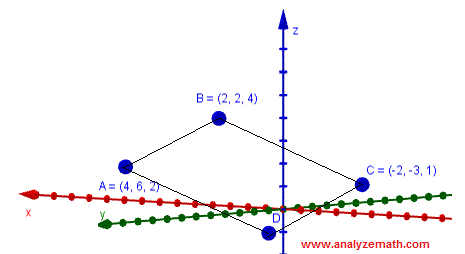
- ) Points A, B, C and D forms a parallelogram.
a)Find the coordinates of point D.
b)Find the area of a parallelogram.
- )) In the cube below find the angle between the diagonals AG and BH.

- )0) Find a vector that is orthogonal to the plane containing the points A(1,2,-3), B(0,-2,1) and C(-2,0,1).
- )) Find the area of the triangle whose vertices are the points A(1,0,-3), B(1,-2,0) and C(0,2,1).
- ))Find the volume of the parallelepiped shown below.

Detailed Solutions and explanations to these questions.
More References and links