This tutorial covers how to compute the probability of an event. Let \( S \) be the sample space of an experiment and \( E \) the event of interest. The number of elements in \( S \) is written \( n(S) \), and the number of elements in \( E \) is written \( n(E) \).
A die is rolled. Find the probability that an even number is obtained.
SolutionThe sample space is \[ S = \{1,2,3,4,5,6\} \] The event “even number” is \[ E = \{2,4,6\} \] Using the classical probability formula, \[ P(E) = \frac{n(E)}{n(S)} = \frac{3}{6} = \frac{1}{2} \]
Two coins are tossed. Find the probability that two heads are obtained.
SolutionThe sample space is \[ S = \{(H,H),(H,T),(T,H),(T,T)\} \] The event “two heads” is \[ E = \{(H,H)\} \] Hence, \[ P(E) = \frac{1}{4} \]
Which of the following cannot be a probability?
A probability must satisfy \( 0 \le P \le 1 \). Therefore, values a) and c) cannot represent probabilities.
Two dice are rolled. Find the probability that the sum is:
The sample space contains \( 36 \) outcomes.
a) No outcome gives a sum of 1, so \[ P = \frac{0}{36} = 0 \]
b) The outcomes are \( \{(1,3),(2,2),(3,1)\} \), hence \[ P = \frac{3}{36} = \frac{1}{12} \]
c) All outcomes give a sum less than 13, so \[ P = \frac{36}{36} = 1 \]
A die is rolled and a coin is tossed. Find the probability that the die shows an odd number and the coin shows a head.
SolutionThe sample space has \( 12 \) outcomes. The favorable outcomes are \[ E = \{(1,H),(3,H),(5,H)\} \] Therefore, \[ P(E) = \frac{3}{12} = \frac{1}{4} \]
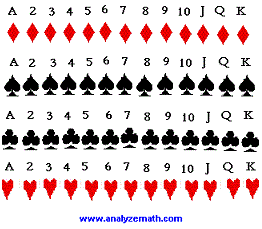
A card is drawn at random from a standard deck. Find the probability of getting the 3 of diamonds.
SolutionThere are \( 52 \) cards in the deck.
\[ P(E) = \frac{1}{52} \]
Find the probability of drawing a queen from a standard deck.
SolutionThere are 4 queens in a deck of 52 cards, so \[ P(E) = \frac{4}{52} = \frac{1}{13} \]
A jar contains 3 red, 7 green, and 10 white marbles. What is the probability of drawing a white marble?
Solution| Color | Frequency |
|---|---|
| Red | 3 |
| Green | 7 |
| White | 10 |
\[ P(E) = \frac{10}{20} = \frac{1}{2} \]
The blood types of 200 people are distributed as follows:
| Group | Frequency |
|---|---|
| A | 50 |
| B | 65 |
| O | 70 |
| AB | 15 |
\[ P(\text{O}) = \frac{70}{200} = 0.35 \]
a) \( \frac{1}{3} \)
b) \( \frac{1}{2} \)
c) \( \frac{1}{9} \)
d) \( \frac{1}{52} \)