Learn how to sketch the sine and cosine functions of the general forms:
$$ y = a \sin\bigl(k (x - d)\bigr) + c \quad \text{and} \quad y = a \cos\bigl(k (x - d)\bigr) + c $$
With clear explanations, step-by-step examples, and detailed solutions, this introduction covers key concepts such as amplitude, period, phase shift, and vertical translation to help you master graphing trigonometric functions.
Graphing Parameters
Amplitude: $ |a| $
Period: $ \dfrac{2\pi}{|k|} $
Horizontal Shift (Phase Shift): $d$. To the left if $-d$ is positive, and to the right if $-d$ is negative.
Vertical Shift: $c$. Up if $c$ is positive, and down if $c$ is negative.
Unit Circle Foundations
In order to sketch transformed sine and cosine functions, we need to know how to sketch basic sine and cosine functions. The unit circle (radius = 1) gives the values of $\sin(x)$ and $\cos(x)$ at 5 key points which can be used to graph more complex functions. The coordinates of any point on the unit circle give the cosine and sine of the angle in standard position corresponding to that point.
- The angle $x = 0$ corresponds to the point: $ (1, 0) = (\cos(0), \sin(0)) $
- The angle $x = \pi/2$ (or 90°) corresponds to the point: $ (0, 1) = (\cos(\pi/2), \sin(\pi/2)) $
- The angle $x = \pi$ (or 180°) corresponds to the point: $ (-1, 0) = (\cos(\pi), \sin(\pi)) $
- The angle $x = 3\pi/2$ (or 270°) corresponds to the point: $ (0, -1) = (\cos(3\pi/2), \sin(3\pi/2)) $
- The angle $x = 2\pi$ (or 360°) corresponds to the point: $ (1, 0) = (\cos(2\pi), \sin(2\pi)) $

Sketching Sine and Cosine Functions: Examples with Detailed Solutions
Example 1: Vertical Stretch and Shift
Sketch the graph of $y = 2 \cos(x) + 1$ over one period.
Solution:
Graphing Parameters
- Amplitude: $|2| = 2$
- Period: $2\pi$
- Vertical Shift: $1$ (up 1 unit)
- Horizontal Shift: $0$
Three steps to graph the function $y = 2 \cos(x) + 1$:
1) We start by sketching $y = \cos(x)$ using the values of $x$ and $y$ from the unit circle (blue graph below).
$$ \begin{array}{|c|c|c|c|c|c|} \hline x & 0 & \dfrac{\pi}{2} & \pi & \dfrac{3\pi}{2} & 2\pi \\ \hline y & 1 & 0 & -1 & 0 & 1 \\ \hline \end{array} $$
2) We then sketch $y = 2 \cos(x)$ by stretching $y = \cos(x)$ by 2 (green graph below).
3) Finally, sketch $y = 2 \cos(x) + 1$ by shifting up 1 unit (red graph below).

Example 2: Vertical Stretch, Shift, and Reflection
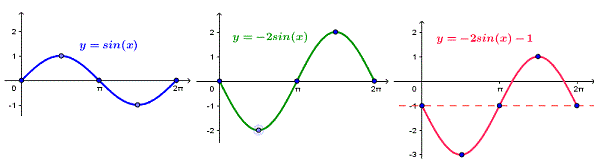
Sketch the graph of $y = - 2 \sin(x) - 1$ over one period.
Solution:
Graphing Parameters
- Amplitude: $|-2| = 2$
- Period: $2\pi$
- Vertical Shift: $-1$ (down 1 unit)
- Horizontal Shift: $0$
Three steps to graph the function $y = - 2 \sin(x) - 1$:
1) We start by sketching $y = \sin(x)$ using the values of $x$ and $y$ from the unit circle (blue graph below).
$$ \begin{array}{|c|c|c|c|c|c|} \hline x & 0 & \dfrac{\pi}{2} & \pi & \dfrac{3\pi}{2} & 2\pi \\ \hline y & 0 & 1 & 0 & -1 & 0 \\ \hline \end{array} $$
2) We then sketch $y = - 2 \sin(x)$ by stretching $y = \sin(x)$ by 2 and reflecting it on the x-axis (green graph below).
3) Finally, sketch $y = - 2 \sin(x) - 1$ by shifting down 1 unit (red graph below).
Example 3: Period Change and Phase Shift
Sketch the graph of $y = 3 \cos(2x + \dfrac{\pi}{3}) - 1$ over one period.
Solution:
Graphing Parameters
- Amplitude: $|3| = 3$
- Period: $\dfrac{2\pi}{2} = \pi$
- Vertical Shift: $-1$ (down 1 unit)
Horizontal Shift: Because of the term $\dfrac{\pi}{3}$, the graph is shifted horizontally. We first rewrite the given function as:
$$ y = 3 \cos\left[ 2\left( x + \dfrac{\pi}{6} \right) \right] - 1 $$
and we can now write the shift as being equal to $\dfrac{\pi}{6}$ to the left.
Three steps to graph the function $y = 3 \cos(2x + \dfrac{\pi}{3}) - 1$:
1) We start by sketching $3 \cos(2x)$ with minimum and maximum values -3 and +3 over one period $= \pi$ (blue graph below).
2) We then sketch $y = 3 \cos(2x) - 1$ translating the previous graph 1 unit down (green graph below).
3) We now shift the previous graph $\dfrac{\pi}{6}$ to the left (red graph below) so that the sketched period starts at $-\dfrac{\pi}{6}$ and ends at $-\dfrac{\pi}{6} + \pi = \dfrac{5\pi}{6}$ which is one period $= \pi$.

Example 4: Decimal Parameters
Sketch the graph of $y = -0.2 \sin\left(0.5x - \dfrac{\pi}{6} \right) + 0.1$ over one period.
Solution:
Graphing Parameters
- Amplitude: $|-0.2| = 0.2$
- Period: $\dfrac{2\pi}{0.5} = 4\pi$
- Vertical Shift: $0.1$ (up 0.1 unit)
Horizontal Shift: Because of the term $- \dfrac{\pi}{6}$, the graph is shifted horizontally. We first rewrite the given function as:
$$ y = -0.2 \sin\left( 0.5\left(x - \dfrac{\pi}{3}\right) \right) + 0.1 $$
and we can now write the shift as being equal to $\dfrac{\pi}{3}$ to the right.
Three steps to graph the function $y = -0.2 \sin\left(0.5x - \dfrac{\pi}{6} \right) + 0.1$:
1) We start by sketching $y = -0.2 \sin(0.5x)$ with minimum and maximum values $-0.2$ and $0.2$ over one period $= 4\pi$ (blue graph below).
2) We then sketch $y = -0.2 \sin(0.5x) + 0.1$ by translating the previous graph 0.1 unit up (green graph below).
3) We then shift the previous graph $\dfrac{\pi}{3}$ to the right (red graph below) so that the sketched period starts at $\dfrac{\pi}{3}$ and ends at $\dfrac{\pi}{3} + 4\pi$, which is one period $= 4\pi$.

Example 5: Working in Degrees
Sketch the graph of $y = 2 \cos(2x - 60^\circ) - 2$ over one period.
Solution:
Graphing Parameters
- Amplitude: $|2| = 2$
- Period: $\dfrac{360^\circ}{2} = 180^\circ$
- Vertical Shift: $-2$ (down 2 units)
Horizontal Shift: Because of the term $-60^\circ$, the graph is shifted horizontally. We first rewrite the given function as:
$$ y = 2 \cos\left[ 2 \left( x - 30^\circ \right) \right] - 2 $$
and we can now write the shift as being equal to $30^\circ$ to the right.
Three steps to graph the function $y = 2 \cos(2x - 60^\circ) - 2$:
1) We start by sketching $y = 2 \cos(2x)$ with minimum and maximum values $-2$ and $+2$ over one period $= 180^\circ$ (blue graph below).
2) We then sketch $y = 2 \cos(2x) - 2$ translating the previous graph 2 units down (green graph below).
3) Finally, we shift the previous graph $30^\circ$ to the right (red graph below) so that the sketched period starts at $30^\circ$ and ends at $30^\circ + 180^\circ = 210^\circ$, which is one period $= 180^\circ$.

Example 6: Fractional Periods
Sketch the graph of $y = -2 \sin\left(\dfrac{x}{3} + \dfrac{\pi}{3}\right) - 1$ over one period.
Solution:
Graphing Parameters
- Amplitude: $|-2| = 2$
- Period: $\dfrac{2\pi}{\dfrac{1}{3}} = 6\pi$
- Vertical Shift: $-1$ (down 1 unit)
Horizontal Shift: Because of the term $\dfrac{\pi}{3}$, the graph is shifted horizontally. We first rewrite the given function as:
$$ y = -2 \sin\left(\dfrac{1}{3}(x + \pi)\right) - 1 $$
and we can now write the shift as being equal to $\pi$ to the left.
Three steps to graph the function $y = -2 \sin\left(\dfrac{x}{3} + \dfrac{\pi}{3}\right) - 1$:
1) We start by sketching $-2 \sin\left(\dfrac{x}{3}\right)$ with minimum and maximum values $-2$ and $+2$ over one period $= 6\pi$ (blue graph below).
2) We then sketch $y = -2 \sin\left(\dfrac{x}{3}\right) - 1$ translating the previous graph 1 unit down (green graph below).
3) We then shift the previous graph $\pi$ to the left (red graph below) so that the sketched period starts at $-\pi$ and ends at $5\pi$ which is one period $= 6\pi$.

More References and Links
- Sine Function
- Cosine Function
- Use Sine Functions to Model Problems
- Cosine Function HTML5 applet
- Tutorial on Sine Functions (1)- Problems
- Middle School Math (Grades 6, 7, 8, 9) - Free Questions and Problems
- High School Math (Grades 10, 11 and 12) - Free Questions and Problems
- Primary Math (Grades 4 and 5) - Free Questions and Problems
- Home Page