Examples with Detailed Solutions
Example 1
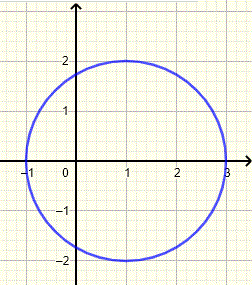
Find the equation of the circle whose graph is shown below.
View Solution
The given graph is symmetric with respect to the x-axis and therefore the center of the circle is the midpoint of the two x-intercepts at the points \( (-1,0) \) and \( (3,0) \). In other words, the two x-intercepts form a diameter of the circle.
Center: The center of the circle is at their midpoint:
\[ \left( \dfrac{-1+3}{2}, \dfrac{0+0}{2} \right) = (1,0) \]Radius: The radius \( r \) of the circle is half the diameter:
\[ r = \dfrac{1}{2} \sqrt{(-1-3)^2 + (0 - 0)^2} = \dfrac{1}{2} \sqrt{16} = 2 \]Equation: The equation of the circle is:
\[ (x - 1)^2 + y^2 = 2^2 \implies (x - 1)^2 + y^2 = 4 \]Example 2
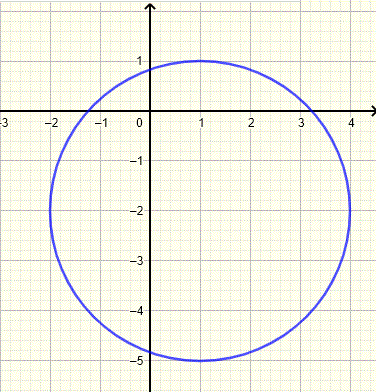
Find the equation of the circle whose graph is shown below.
View Solution
We first draw two perpendicular axes of symmetry (broken lines) of the circle to locate the center.

From the graph with axes of symmetry, we can approximate the center to be at \( (1,-2) \).
The points of intersection of the circle with any of the two axes give a diameter of about 6 units, so the radius is half of that:
\[ r = \dfrac{6}{2} = 3 \]Equation: The equation of the circle is:
\[ (x - 1)^2 + (y + 2)^2 = 3^2 \implies (x - 1)^2 + (y + 2)^2 = 9 \]Example 3
Find the equation of the circle whose graph is shown below including three points on the circle.
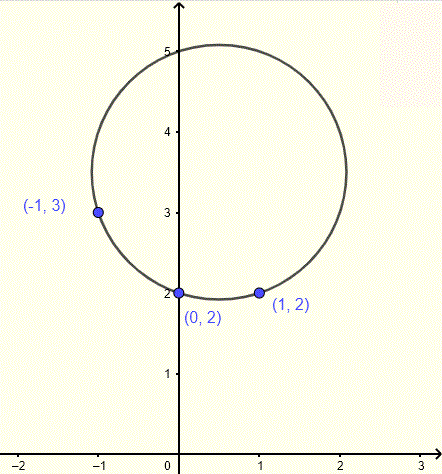
View Solution
Let \( (h, k) \) be the center of the circle. The three points \( (-1,3) \), \( (0,2) \), and \( (1,2) \) are on the circle, so the distance from each point to the center equals the radius.
The squared distances from the center to each point are:
- To \( (-1,3) \): \( (h + 1)^2 + (k - 3)^2 \)
- To \( (0,2) \): \( h^2 + (k - 2)^2 \)
- To \( (1,2) \): \( (h - 1)^2 + (k - 2)^2 \)
Since all distances are equal, we set up equations:
\[ \begin{cases} (h + 1)^2 + (k - 3)^2 = h^2 + (k - 2)^2 \\[5pt] h^2 + (k - 2)^2 = (h - 1)^2 + (k - 2)^2 \end{cases} \]Simplify the second equation:
\[ h^2 = (h - 1)^2 \implies h^2 = h^2 - 2h + 1 \implies 0 = -2h + 1 \quad \Rightarrow \quad h = \dfrac{1}{2} \]Substitute \( h = \frac{1}{2} \) into the first equation:
\[ \left(\dfrac{1}{2} + 1\right)^2 + (k - 3)^2 = \left(\dfrac{1}{2}\right)^2 + (k - 2)^2 \] \[ \left(\dfrac{3}{2}\right)^2 + (k - 3)^2 = \dfrac{1}{4} + (k - 2)^2 \] \[ \dfrac{9}{4} + k^2 - 6k + 9 = \dfrac{1}{4} + k^2 - 4k + 4 \implies -6k + \dfrac{45}{4} = -4k + \dfrac{17}{4} \] \[ -2k = -\dfrac{28}{4} \quad \Rightarrow \quad k = \dfrac{7}{2} \]Center: \( (h,k) = \left(\dfrac{1}{2}, \dfrac{7}{2}\right) \)
Radius: Using point \( (0,2) \):
\[ r = \sqrt{ \left(\dfrac{1}{2} - 0\right)^2 + \left(\dfrac{7}{2} - 2\right)^2 } = \sqrt{ \dfrac{1}{4} + \dfrac{9}{4} } = \sqrt{ \dfrac{10}{4} } = \sqrt{ \dfrac{5}{2} } \]Equation:
\[ \left(x - \dfrac{1}{2}\right)^2 + \left(y - \dfrac{7}{2}\right)^2 = \dfrac{5}{2} \]The three points circle calculator may be used to check answers and generate more problems[cite: 1].